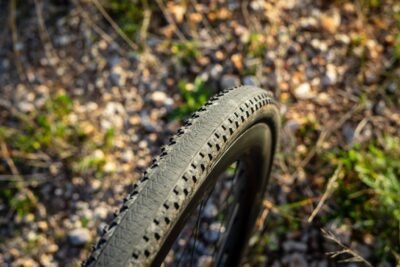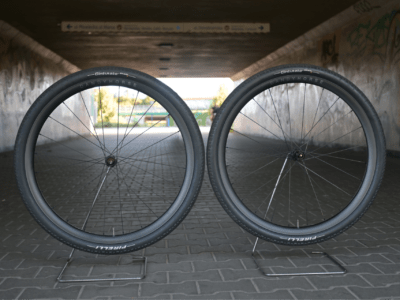

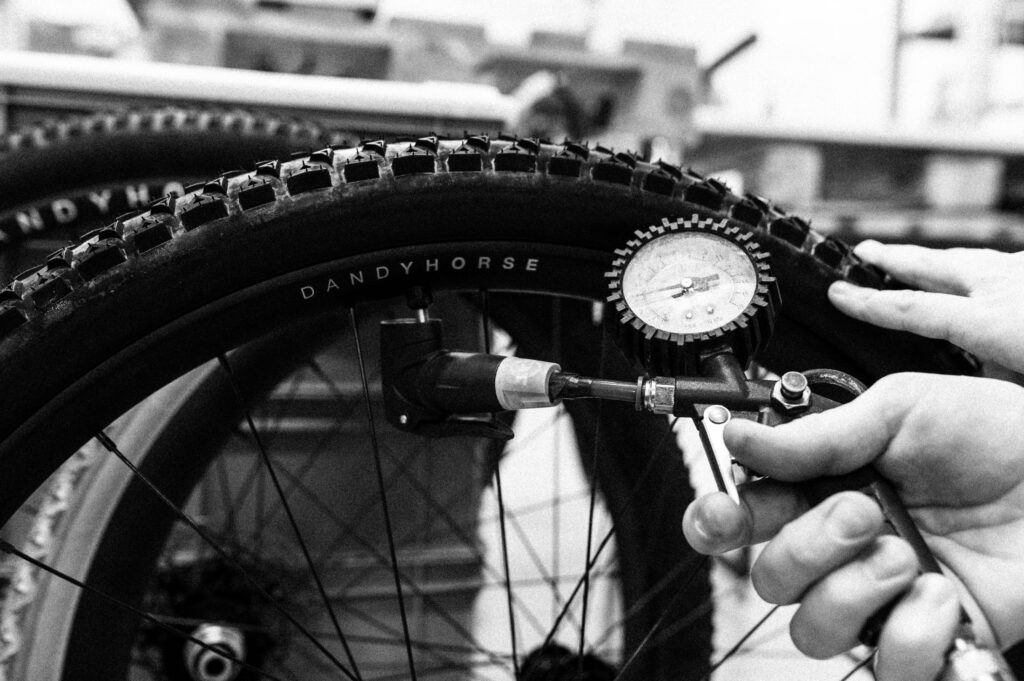
In our opinion, tires are the most important part of a bicycle, as the properties of the tires have the greatest impact on the bicycle’s characteristics. This is especially noticeable in gravel riding – the same bike with narrow, tightly inflated slick tires will behave like an endurance road bike, but with weakly inflated wide tires with an aggressive tread, it will behave more like an XC hardtail. Adjusting the air pressure in the tires itself allows you to change the behavior of the bike to a certain extent. In theory, the relationship is simple – the more bars, the lower the rolling resistance at the expense of riding comfort and grip, and the lower the pressure, the higher the rolling resistance, the better the traction and comfort. However, in practice, it is not that simple.
Rolling resistance is created by the deformation of the tire in contact with the surface and due to friction between the tube and the tire. In an ideal world, on an absolutely smooth surface, the relationship between pressure and rolling resistance is simple – the harder the rubber, the lower the resistance. However, in the real world, nothing is ideal. Every surface, even fresh asphalt, has its roughness. A more tightly inflated tire does not match the surface’s irregularities, which causes energy loss. Therefore, the rule “the more, the better” does not apply in this case.
Dobór odpowiedniego ciśnienia pozwala znaleźć złoty balans pomiędzy oporami toczenia, przyczepnością, a komfortem jazdy. Aby ustalić optymalne ciśnienie w oponach trzeba pod uwagę następujące czynniki:
– Minimalne i maksymalne ciśnienie przewidziane przez producenta opony;
– Maksymalne ciśnienie dla obręczy określone przez producenta kół;
– Konstrukcję rantu obręczy (hookless czy hooked);
– Szerokość opony;
– Szerokość wewnętrzną obręczy;
– Masę zawodnika i roweru;
– Rodzaj nawierzchni;
– Typ opony, oraz sposób jej uszczelnienia.
The following tire pressure calculator can help you calculate the optimal pressure:
https://axs.sram.com/guides/tire/pressure
If for a given tire and rim configuration, the optimal pressure exceeds the maximum value specified by the manufacturer of any of the components, we recommend switching to wider tires. Never exceed the maximum specified pressure, as this will void the warranty.
Share:

Subscribe to our newsletter
We only send what matters: new model launches, technical tips, and huge deals. It’s worth staying in touch.